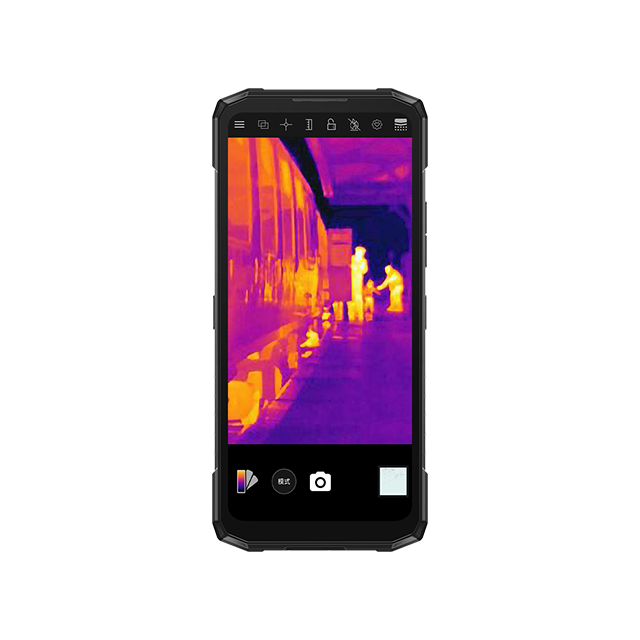
Challenge the traditional reliance on single-purpose, isolated Ex-certified cameras for industrial inspections. For decades, frontline teams treated thermal data collection and daily field communication as entirely separate tasks. This outdated mindset forces technicians to carry multiple bulky tools into highly volatile environments. Frontline workers in ATEX/IECEx classified zones require immediate data transfer to make safe decisions. However, legacy tools rely heavily on delayed, manual data retrieval. You often have to wait until returning to a safe zone to extract a physical SD card. They lack real-time connectivity precisely when seconds matter most.
Deploying an enterprise-grade thermal imaging smartphone bridges the gap between predictive maintenance and instant communication. It reduces heavy tool weight, streamlines IT management, and accelerates critical safety responses. This modernization transforms a reactive safety culture into a proactive one. When you integrate high-quality imaging directly into a connected device, you empower workers to diagnose, report, and resolve anomalies instantly.
Key Takeaways
A combined communication and thermal device eliminates the latency of traditional non-connected Ex-cameras via immediate 5G/Wi-Fi cloud syncing.
Evaluating Intrinsically Safe Infrared Thermal Imaging requires looking past megapixel counts to focus on Thermal Sensitivity (NETD) and dual-light fusion capabilities.
Enterprise adoption hinges on both physical compliance (ATEX Zone 1/2) and IT security controls (e.g., Kiosk mode to restrict unauthorized applications).
High-ROI applications center on predictive maintenance, allowing non-contact temperature readings of high-voltage or high-friction assets without halting operations.
The Business Case: Why Consolidate Communication and Thermal Inspection?
Traditional intrinsically safe thermal cameras create major operational bottlenecks. They capture excellent data but trap it inside isolated silos. To process an inspection report, technicians must leave the hazardous area, enter a safe zone, remove an SD card, and manually upload files to a computer. This physical media transfer introduces severe delays and risks data loss. It also forces workers to wear heavy multi-device toolbelts, reducing their mobility in tight industrial spaces.
A unified smart device acts as a comprehensive convergence solution. You replace isolated hardware with a single connected platform. This integration completely transforms daily field operations. Frontline teams gain the ability to capture thermal anomalies and immediately sync them to enterprise asset management systems over 5G or LTE networks.
The outcomes focus squarely on immediate collaboration and operational efficiency. When a worker spots an overheating pump, they do not just record it for later. They can initiate a remote video call using the front-facing camera, sharing real-time context with off-site engineers. This digital workflow integration eliminates redundant data entry, accelerates decision-making, and keeps your workforce agile and unburdened by excessive equipment.
Hardware Evaluation: Decoding Thermal Specs for Industrial Accuracy
Many buyers focus heavily on visible-light megapixels. However, effective industrial thermal inspection requires a completely different set of metrics. You must evaluate thermal sensitivity, resolution, and integration technology to ensure reliable predictive maintenance.
Thermal Sensitivity, measured in Noise Equivalent Temperature Difference (NETD), dictates how well a sensor detects minute temperature variations. An NETD of <50 mK, or ideally <40 mK, is critical. It allows you to identify subtle moisture ingress under insulation or early-stage electrical resistance. Poor sensitivity blurs these crucial temperature boundaries, rendering the inspection useless.
Sensor resolution and pixel pitch directly impact your safe standoff distance. A baseline resolution of 256x192 is widely recommended for industrial environments. Higher resolutions paired with a smaller pixel pitch allow operators to accurately read temperatures on high-voltage switchgear from a safe distance, minimizing arc flash exposure.
You also need robust Dual-Light Fusion Technology. Raw thermal feeds often look like vague, colorful blobs in complex environments. Dual-light algorithms overlay visible light outlines directly onto the thermal image. This fusion helps technicians pinpoint exact component locations in dense engine rooms or crowded electrical panels.
Finally, consider the form factor. Fully built-in sensors offer extreme durability and immediate access. Alternatively, modular systems utilize secure, intrinsically safe expansion ports, such as 13-pin ISM interfaces, to attach thermal modules only when needed.
Feature
Consumer-Grade Smartphone
Industrial Thermal Smartphone
Sensor Sensitivity (NETD)
Rarely included, or >100 mK
<50 mK (High precision for subtle leaks)
Software Integration
Basic color palettes
Dual-Light Fusion, ISoceles measurement overlays
Hardware Expansion
Standard USB-C (Not safe for Ex zones)
13-pin ISM interface for secure modules
Navigating Compliance: Hazardous Certification and Usability Realities
Bringing electronics into volatile environments demands strict adherence to regulatory baselines. Basic ruggedness metrics like IP68, IP69K, and MIL-STD-810G guarantee protection against water, dust, and physical drops. However, they do not mean a device is intrinsically safe.
True intrinsic safety prevents the device from generating sparks or accumulating surface heat sufficient to ignite surrounding gases or dust. You must ensure the hardware carries specific non-negotiable certifications such as ATEX Zone 1/2, IECEx, or Class I Div 1/2, depending on your region and facility classification.
Beyond certifications, ergonomics dictate how effectively frontline teams can use the device. Hazardous area workers operate in extreme conditions, making standard touchscreen navigation nearly impossible. You need specific physical design necessities:
Glove Mode & Wet-Tracking: Screens must function reliably when workers wear heavy PPE or operate in driving rain.
Programmable Hardware Keys: Dedicated physical buttons allow users to bypass complex touchscreen menus. You can configure them for Push-to-Talk (PTT), emergency SOS alerts, or an instant thermal camera launch.
Operating Temperature Tolerances: The device must maintain verifiable battery performance and screen responsiveness in extreme climates, typically ranging from -20°C to +60°C.
Best Practice: Always implement immediate quarantine protocols. If the ruggedized glass cracks, the physical housing is compromised, which usually voids the Ex-certification instantly. Remove it from the hazardous zone immediately.
High-ROI Inspection Scenarios in Hazardous Zones
Deploying advanced imaging tools unlocks new operational capabilities. Teams can transition from reactive repairs to proactive monitoring across various heavy industry sectors.
Electrical Load & Switchgear Monitoring: Utilizing Intrinsically Safe Infrared Thermal Imaging allows technicians to identify loose connections or phase imbalances. Following standards like NFPA 70B, you should inspect panels under peak load. A thermal sensor lets you spot these anomalies safely without opening energized cabinets.
Mechanical & Petrochemical Assets: In highly volatile oil and gas environments, early detection prevents catastrophic failure. Workers can spot pump overheating, bearing friction, or blocked pipework instantly. You identify the exact point of failure before it halts production.
Low-Visibility Security & Search: Fog, darkness, and heavy industrial smoke render standard cameras useless. Thermal signatures allow security personnel to monitor restricted perimeters effectively, tracking unauthorized personnel or missing workers regardless of visual obstructions.
Waste Management & Fire Prevention: Chemical storage and waste decomposition areas harbor hidden dangers. Spontaneous, concealed heat build-up occurs deep within material piles. Visible light cameras cannot detect this, but regular thermal sweeps catch rising temperatures long before a fire ignites.
IT Deployment Strategies and Enterprise Security Risks
Management often expresses skepticism regarding smartphones in industrial zones. They worry about worker distraction, unapproved software, and network vulnerabilities. You must proactively address these concerns through rigorous IT deployment strategies.
To mitigate distraction and misuse, implement "Kiosk Mode." This configuration turns the device into a camera-only variant. It locks down the operating system, disables non-essential apps, and restricts the user strictly to inspection and reporting workflows. You maintain the power of a smart device while enforcing the discipline of a dedicated tool.
Data integrity and privacy represent another major hurdle. Modern thermal inspection apps must handle on-device processing securely. You must configure mobile device policies to route all data through secure corporate networks. This prevents unauthorized external cloud syncs, ensuring sensitive infrastructure imagery never leaks to public servers.
Finally, you need to focus on future-proofing the fleet. Do not buy hardware based on current specs alone. Evaluate devices based on their Android Enterprise Recommended (AER) status. AER certification guarantees seamless Mobile Device Management (MDM) integration. It also ensures long-term security patching and mandatory OS version upgrades, keeping your field equipment secure against evolving cyber threats.
Conclusion
Transitioning away from isolated cameras is not merely an equipment upgrade; it is a fundamental workflow modernization. It successfully merges predictive maintenance with unified communications. You empower your workforce to detect hidden anomalies and collaborate on solutions instantly without breaking hazardous area compliance.
Start your procurement process with a targeted pilot program. Select a specific, high-friction inspection route to test the hardware's durability and sensor accuracy. Before a full fleet rollout, establish baseline IT security policies, including strict MDM enrollment and Kiosk Mode configurations. Taking these intentional steps ensures a smooth, secure transition to connected field operations.
FAQ
Q: Can a thermal imaging smartphone see through walls or enclosures?
A: No. Thermal sensors do not have X-ray vision. They read surface temperature differentials. The device can detect heat transferring to a surface—such as a hot pipe warming a thin panel from behind—but it only visualizes the heat radiating off that outer layer, not the object behind it.
Q: How does the thermal accuracy of a smartphone compare to a dedicated high-end industrial thermal camera?
A: Smartphones are ideal for daily, frontline predictive screening and fast documentation. They generally remain accurate within ±2°C for industrial ranges. However, highly specialized R&D tasks or extreme long-range diagnostics may still require dedicated, larger-lens thermal units.
Q: What happens to the intrinsically safe certification if the screen cracks?
A: A compromised physical housing usually voids the Ex-certification immediately. The broken seal could allow combustible gases to contact internal electronics. You must rely on chemically strengthened glass and implement strict quarantine protocols to remove damaged devices from hazardous zones instantly.